



-
 Written By:
Erin Andrade, LICSW
Written By:
Erin Andrade, LICSW
-
Edited By:
Phyllis Rodriguez, PMHNP-BC
-
Clinically Reviewed By:
Dr. Ash Bhatt, MD, MRO
 Written By:
 Edited By:
 Clinically Reviewed By:
Key Takeaways
- Snorting Percocet exposes you to a second, hidden risk, which is a rise in acetaminophen levels in your blood from nasal misuse alone, despite never swallowing a pill.
- Smoking Percocet is not the safer alternative it’s often assumed to be. Heating the tablet destroys an unpredictable portion of the oxycodone before it’s ever inhaled, which means people often use more to compensate, raising overdose risk rather than lowering it.
- Changing how you take Percocet doesn’t automatically mean addiction, but it’s rarely meaningless. Clinically, it’s one of the clearest signs that use has shifted from managing pain to managing the drug’s effects, and it’s often the detail that gets missed until it’s brought up directly.
Percocet is prescribed as an oral medication containing oxycodone, an opioid, and acetaminophen. Snorting or smoking Percocet changes how the medication is used and can increase the risk of serious harm, including opioid overdose, dependence, and damage to the tissues exposed to the drug. Snorting also creates a separate concern that is easy to overlook: Percocet contains acetaminophen, and there is documented evidence that nasal misuse can result in clinically significant acetaminophen exposure.
In this article, we’ll break down what actually happens in the body when Percocet is snorted or smoked, why that change carries risks, and which warning signs suggest the behavior has moved beyond a one-time experiment. We’ll also cover how clinicians evaluate this pattern, what to do in a suspected overdose, and what treatment actually involves.
What Does It Mean to Snort or Smoke Percocet?
Snorting Percocet means crushing the tablet and inhaling the powder through the nose; smoking usually means heating crushed pills on foil and inhaling the vapor. Both methods bypass the oral route Percocet was designed and tested for.
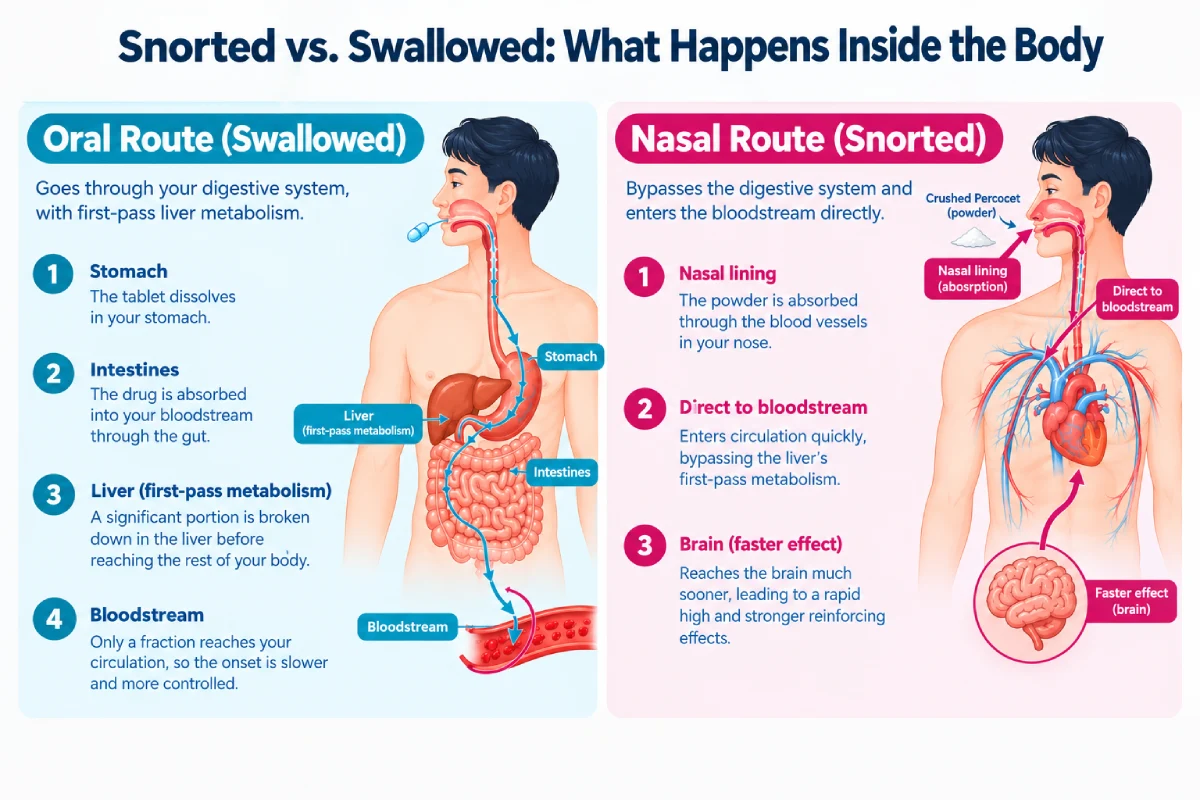
Percocet combines oxycodone, an opioid, with acetaminophen, a non-opioid pain reliever, in an immediate-release tablet meant to be swallowed and absorbed through the digestive tract. The current prescribing information specifically warns that oxycodone carries risks of addiction, misuse, respiratory depression, and overdose, risks that don’t disappear when someone changes how they take it, according to the medication’s official labeling.
Can you snort Percocet? People do misuse it this way, but that doesn’t mean it’s safe or effective. The DEA’s oxycodone fact sheet classifies oxycodone as a Schedule II controlled substance precisely because altering its intended route significantly raises its potential for misuse.
Here’s how the two methods actually compare:
| Snorting | Smoking | |
| Onset speed | Very fast (minutes) | Fast, but inconsistent |
| Drug delivered | High percentage absorbed through nasal tissue | Significant portion destroyed by heat before inhalation |
| Primary tissue damage | Nasal lining, sinuses, septum | Airways, lungs |
| Clinical evidence base | Larger, studied in intranasal oxycodone research | Limited, few studies specifically examine smoked Percocet |
Clinical Perspective from Dr Ash Bhatt: Smoking is generally considered a less “efficient” way to misuse oxycodone than snorting it. Harm reduction research on alternative routes of administration notes that oxycodone doesn’t vaporize cleanly, so a portion simply burns off before it reaches the lungs, which is why some people who start out smoking pills eventually move to snorting or injecting to get a more consistent effect.
Why Snorting or Smoking Percocet Is More Dangerous Than Taking It as Prescribed
Snorting or smoking Percocet removes the built-in delay between taking the medication and feeling its effects, a delay that exists specifically to control how much of the drug reaches the brain at once. That delay is what makes the prescribed dose predictable.
When Percocet is swallowed, oxycodone passes through first-pass liver metabolism before entering circulation, which reduces and slows the amount reaching the bloodstream. NIDA’s DrugFacts on prescription opioids explains that altering the intended route, crushing, snorting, or smoking a pill meant to be swallowed, allows the drug to enter the bloodstream faster and in higher concentrations than intended.
Studies on intranasal oxycodone have also shown measurable reinforcing effects in people with a history of recreational opioid use, which helps explain the behavioral pull toward snorting once someone has tried it. That pull matters because it can turn an isolated experiment into a repeated pattern, one our medication-assisted treatment program is specifically designed to interrupt once cravings take hold.
Overdose risk climbs further when Percocet is combined with other central nervous system depressants. The FDA’s labeling warns that mixing opioids with alcohol or benzodiazepines can cause profound sedation, respiratory depression, coma, and death, a risk that changing the route only intensifies, never reduces.
The Hidden Acetaminophen Risk Snorting Percocet Creates
One of the most important reasons Percocet should not be treated as simply “oxycodone” is that it contains acetaminophen.
Acetaminophen is commonly recognized as an over-the-counter pain reliever, but excessive exposure can cause severe liver injury. The complication becomes particularly relevant when a person is using Percocet in an unintended way because the amount of acetaminophen absorbed through a non-oral route may not be predictable.
The published case of intranasal Percocet misuse is particularly instructive. The patient developed a measurable acetaminophen concentration after nasal insufflation, even though she reported not taking the medication orally. The case authors noted that clinicians should remain alert to toxicity from accompanying ingredients in prescription opioid preparations used through non-oral routes.
This is a useful correction to a common misconception:
“If I am snorting Percocet instead of swallowing it, I am only getting the oxycodone.”
That assumption is not reliable.
The formulation contains more than oxycodone, and changing the route does not make the other ingredients disappear.
Clinical Perspective from Dr Ash Bhatt: Acetaminophen overexposure is one of the leading causes of acute liver injury in the U.S., yet almost no one thinks to connect that risk to snorting a prescription painkiller. The common assumption, “I’m only getting the oxycodone this way”, isn’t reliable. The rest of the tablet doesn’t disappear; it just enters the body through a route that wasn’t studied for it.
Recognizing the Shift: Signs Someone Has Changed How They Take Percocet
Snorting Percocet is already a form of medication misuse when it is done outside the prescribed route. However, misuse and opioid use disorder are not interchangeable terms.
A person can misuse an opioid without meeting diagnostic criteria for OUD. Conversely, someone with OUD may not always snort or smoke the drug.
The concern becomes greater when route changes occur alongside a broader pattern of loss of control.
Look for changes such as:
- Taking Percocet for its effects rather than primarily for pain
- Thinking frequently about when or how to obtain the next supply
- Using more medication than intended
- Taking medication earlier than planned
- Running out of a prescription before the expected refill
- Seeking prescriptions from multiple sources
- Becoming secretive about use
- Continuing to use despite health, relationship, financial, or work consequences
- Repeatedly trying and failing to cut back
- Experiencing cravings
- Feeling withdrawal symptoms when use is reduced or stopped
- Organizing daily activities around obtaining or using Percocet
- Continuing the behavior despite concern from a doctor, partner, family member, or friend
The combination matters more than any single sign.
For example, a person who once snorted a Percocet tablet may not necessarily have OUD. But someone who is repeatedly changing routes, thinking about Percocet throughout the day, running out early, hiding use, and struggling to stop deserves a professional assessment.
Why This Pattern Often Goes Unnoticed
Route-of-administration changes are frequently missed because they don’t resemble what most families picture as “drug abuse.” A crushed pill doesn’t come with the paraphernalia people associate with illicit drug use, and there’s a common assumption that a doctor-prescribed medication is inherently less dangerous to misuse than a street drug.
That assumption doesn’t hold up clinically. Oxycodone sits at the same DEA control schedule as drugs widely recognized as high-risk, specifically because its misuse potential is comparable, not lower, once someone changes how they use it.
There’s also a specific misconception worth correcting directly: snorting Percocet is sometimes treated as “just a faster way to take the same medication.” It isn’t. The route changes both the speed of the opioid’s effects and the predictability of exposure to the acetaminophen it’s paired with, two separate risks stacked on top of each other.
How Route Change Fits Into a Larger Pattern of Percocet Misuse
Changing how Percocet is taken rarely happens on its own, it’s usually one step in a progression that starts with a legitimate prescription. A person is typically prescribed Percocet for real pain, whether from surgery, an injury, or a chronic condition.
Over time, tolerance can build, or the medication may start to feel like it’s doing more than relieving pain, offering relaxation or emotional relief that the person begins to notice and, eventually, seek out. Rather than raising that change with a doctor, some people respond by taking the medication differently, hoping a faster or stronger effect will solve a problem the original prescription no longer addresses.
That intensified effect tends to reinforce the behavior. Cravings and preoccupation with the drug’s effects gradually outweigh its original purpose, attempts to cut back become harder, and withdrawal or loss of control keep the pattern going even as consequences build at work, at home, or in relationships. This is the point at which pain management has quietly become opioid use disorder, a diagnosable condition that requires medical assessment, not willpower alone.
Misuse vs. Opioid Use Disorder: Why the Distinction Matters
Snorting or smoking Percocet is already medication misuse, since it departs from the prescribed route, but misuse and opioid use disorder (OUD) are not the same thing, and treating them as identical creates real problems in both directions.
Consider two people who each tell their doctor the medication “isn’t working like it used to.”
Person A takes Percocet exactly as prescribed but finds their pain is no longer adequately controlled. Their clinician needs to reassess the pain itself, the treatment plan, and possible alternatives.
Person B has started changing how they take Percocet because they want a stronger or faster effect, and they’ve become preoccupied with when they can use it again. Their clinician needs to screen for medication misuse and OUD.
Both patients used the same sentence. The clinical response is entirely different, which is exactly why simply asking “how many pills are you taking” often isn’t enough to catch what’s actually happening.
Clinical Insights from Dr Ash Bhatt: Labeling every instance of misuse as full-blown “addiction” can backfire. It creates stigma that makes people less likely to be honest with a doctor about what’s changed. The more useful question isn’t “am I an addict” — it’s “what has changed in how I’m using this, and am I losing control over something that’s starting to cause harm?”
How Clinicians Evaluate This Pattern
A clinician does not diagnose opioid use disorder solely because someone has snorted or smoked Percocet. Instead, the route of administration becomes one piece of a broader assessment.
An evaluation may explore:
- Why Percocet was originally prescribed
Was it for surgery, an injury, another acute condition, or ongoing pain? - How use has changed
Has the person increased frequency, amount, or changed the route? - What happens when the medication is unavailable
Are there cravings, withdrawal symptoms, or a strong drive to obtain more? - Whether use is controlled
Has the person tried to reduce or stop but been unable to do so? - Consequences
Has use affected health, relationships, employment, finances, or responsibilities? - Other substances and medications
Clinicians may ask about alcohol, benzodiazepines, illicit opioids, and other drugs because combinations can substantially alter overdose risk. CDC guidance recommends assessing other substance use when treating OUD. - Physical health
Depending on the history, clinicians may need to assess breathing problems, liver concerns, nasal injury, pain, and other medical complications.
The goal is not to punish someone for admitting that they snort Percocet. The goal is to determine what is happening medically and identify the safest next step.
When Is Snorting or Smoking Percocet an Emergency?
If someone who has used Percocet cannot be awakened, is breathing slowly or shallowly, makes choking or gurgling sounds, has discolored lips or skin, or has very small pupils, treat the situation as a possible opioid overdose.
Do not wait to see whether the person “sleeps it off.”
If naloxone is available, administer it and call 911. Keep the person on their side if possible and remain with them while emergency assistance is coming. CDC guidance emphasizes treating a suspected overdose as an overdose when there is uncertainty because acting quickly can save a life.
Naloxone is not harmful to someone who is not experiencing an opioid overdose, so uncertainty should not be a reason to delay using it when an overdose is suspected.
What Treatment for Percocet Misuse Actually Involves
Treatment depends on what the assessment finds. Someone who has begun misusing Percocet but does not have OUD may need a different intervention from someone experiencing established opioid dependence and loss of control.
For people with OUD, evidence-based treatment can include medications such as buprenorphine, methadone, or naltrexone, alongside behavioral and psychosocial support when appropriate. These medications address the physiological and behavioral components of OUD rather than simply asking a person to rely on willpower.
The appropriate level of care can also differ.
- Medical detox, managing withdrawal safely under clinical supervision
- Medication-assisted treatment (MAT), reducing cravings and stabilizing brain chemistry
- Residential or inpatient care, for those needing a structured environment away from triggers
- Outpatient programs, for people able to maintain daily responsibilities during treatment
- Dual diagnosis care, when anxiety, depression, or chronic pain are contributing to the pattern
- Aftercare and relapse prevention planning, since OUD carries an ongoing relapse risk after treatment ends
Early evaluation can identify problems while there are still opportunities to intervene before an overdose, major health complication, or severe disruption to work and relationships occurs.
If You’re Worried About Someone Else’s Percocet Use
Family members often notice a route change before the person using recognizes it as a problem. The most useful conversation focuses on observable behavior rather than accusations, for example:
“I’ve noticed you’ve been using the medication differently, and you’re running out earlier than expected. I’m worried about what that could mean for your health. Would you be willing to talk with a doctor about it?”
That approach leaves room for the person to discuss pain, cravings, withdrawal, anxiety, or other reasons for the change.
Stigma can become a barrier to treatment. CDC guidance specifically emphasizes that opioid use disorder is a medical condition and that reducing stigma can make it easier for people to seek care and support.
If overdose is suspected, however, the situation is no longer a conversation about treatment readiness. It is an emergency.
A Practical Way to Think About the Risk
The most important distinction is between taking Percocet for its intended therapeutic purpose and increasingly using the medication for the way it changes how you feel.
A person may begin with legitimate pain treatment. Tolerance or inadequate pain control may develop. The person may then begin taking the medication differently, including changing the route. The faster or more noticeable effect can reinforce the behavior. Over time, the focus may shift from managing pain to managing cravings, avoiding withdrawal, or pursuing the drug’s effects.
That is the point at which professional evaluation becomes particularly important.
Snorting or smoking Percocet does not prove that someone has developed OUD. But it is not a harmless experiment either.
A route change can be an early clinical signal that the relationship with the medication is changing.
Recognizing that signal early can create an opportunity to address the problem before it progresses to severe dependence, overdose, or major disruption to a person’s life.
We work with patients moving through exactly this kind of transition, from prescription use to a pattern that’s become harder to control, with medical oversight built into our opioid use disorder treatment track from intake onward.
Call at 888-534-2295 or fill out the Contact Us form
Trusted Resources
- Centers for Disease Control and Prevention (CDC): Information on opioid overdose prevention, naloxone, and evidence-based treatment for opioid use disorder. CDC Opioid Overdose Prevention
- Substance Abuse and Mental Health Services Administration (SAMHSA): Evidence-based information about medications for opioid use disorder and treatment services. SAMHSA Medications for Opioid Use Disorder
- Massachusetts Substance Use Helpline: Free, confidential statewide treatment and recovery referral service available 24/7. Massachusetts Substance Use Helpline
- National Institute on Drug Abuse (NIDA): Evidence-based information about opioids, misuse, addiction, overdose, and treatment. NIDA Opioids