



-
 Written By:
Erin Andrade, LICSW
-
Edited By:
Phyllis Rodriguez, PMHNP-BC
-
Clinically Reviewed By:
Dr. Ash Bhatt, MD, MRO
 Written By:
 Edited By:
 Clinically Reviewed By:
Key Takeaways
- A relapse during IOP usually starts with a safety check and a reassessment. Many programs do not discharge someone for a relapse alone, though policies differ.
- Telling your team quickly, and giving the substance, amount, and timing, helps them decide whether withdrawal or overdose is a risk right now.
- Tolerance drops during sobriety, so a dose that was once usual can cause an overdose. Suddenly stopping heavy alcohol or benzodiazepine use can cause seizures and needs medical guidance.
- Whether you stay in IOP, move to PHP or residential care, or need detox depends on several factors together, including physical health, mental health, and home safety. No single factor decides it.
If you relapse during an intensive outpatient program (IOP), your treatment team will first assess your immediate safety, then determine whether your current level of care is still appropriate. Relapse does not automatically mean discharge. Depending on the substance, amount used, withdrawal or overdose risks, mental health, and home environment, your team may adjust your treatment plan or recommend detox, a partial hospitalization program (PHP), or residential care.
Understanding what happens next can make it easier to seek help promptly. This guide explains how clinicians respond, what changes after a relapse, and what to expect regarding treatment, discharge, insurance, and confidentiality.
How IOP Programs Respond To A Relapse In The First Hours
The first hours after a relapse follow the same order in most programs. Medical safety comes first, an honest account of what happened comes second, and decisions about treatment come last. The team cannot decide about treatment until it knows the first two.
When You Tell Your Therapist About The Relapse
Telling your therapist that you used starts a clinical conversation, and it is usually calmer than people expect. The clinician will want specific details. Most of the questions fall into a few groups:
- Which substances you used, including anything taken together, such as alcohol with a sedative.
- How much you used, how you took it, and when.
- Whether you were alone, and whether you still have any of the substance at home.
- Any symptoms since then, such as shaking, sweating, nausea, chest pain, or confusion.
- What was happening in the days before, and which medications you take.
Each question has a purpose. Amount and timing tell the team whether withdrawal or overdose is a concern tonight, and the list of substances matters because mixing them changes the risk. A vague answer such as “I slipped a little” forces the clinician to guess at the details that decide how urgent the situation is.
A good program builds substance monitoring into care so the plan can be adjusted if relapse occurs. Your disclosure is the earliest and most useful form of that information.
When A Drug Or Alcohol Test Comes Back Positive
A positive test shows that a substance was present. It does not show how much you used, whether you used once or several times, or exactly when. Detection depends on how often you use, the amount, your metabolism, the cutoff the test applies, and how long ago you last used in fact creening tests can also return false positives and false negatives.
One well-known gap involves fentanyl. The UCSF hospital handbook notes that fentanyl is usually not detected on routine opiate screens, so a negative result on a standard panel does not rule out fentanyl use. SAMHSA’s TIP 47 recommends urine drug screens and Breathalyzer tests as an objective check on self-reported abstinence, which means programs use testing and your own account together.
Because of these limits, clinicians read a result next to what you tell them. A positive screen may be followed by a confirmatory lab test, and a result that does not match your account usually leads to more questions. The table shows how the same result can lead to different conversations.
| Situation | What the team usually weighs | What may follow |
| You reported the use before the test | The result confirms your account, so the focus moves to safety and the plan | Reassessment, possibly more frequent testing |
| The test finds use you had not mentioned | How recent the use was, how much, and why it went unreported | A direct conversation, a confirmatory test, closer monitoring |
| You report use, but the test is negative | The panel may not include the substance, or the detection window may have passed | A broader panel, and your report is still taken seriously |
| You believe the result is wrong | False positives happen, particularly on rapid screens | A confirmatory lab test and a review of the medications you take |
Each program sets its own testing rules. Ask yours how often you will be tested after a relapse and what a positive result changes.
When You Arrive Intoxicated Or In Withdrawal
Arriving at IOP intoxicated or in withdrawal is a safety situation. Group therapy requires that you can think clearly and take part, and a person who is impaired or physically unwell cannot do either. Staff may ask you to sit out, check your vital signs, ask when you last used, and arrange a medical evaluation. If symptoms look serious, they will send you to an emergency department. This is a decision about that day and does not remove you from the program.
Alcohol needs particular attention because its withdrawal timeline is well mapped. MedlinePlus reports that withdrawal seizures are most common 12 to 48 hours after the last drink. It also reports that delirium tremens, a severe form of withdrawal, most often begins 48 to 96 hours after the last drink and can appear 7 to 10 days later.
If you have been drinking heavily and notice tremors, confusion, hallucinations, fever, or a racing heart, call 911 or go to an emergency room. Do not wait for your next session.
How Clinicians Judge The Seriousness Of A Relapse
Clinicians use a structured framework, and the most widely used one in the United States is The ASAM Criteria from the American Society of Addiction Medicine. It covers six areas:
- Intoxication, withdrawal, and medication needs.
- Physical health.
- Psychiatric and cognitive conditions.
- The risk of further substance use and related behavior.
- Your recovery environment.
- Your own preferences and barriers to care.
A relapse touches nearly all six, which is why two people with the same relapse can receive different recommendations.
One Episode Versus Repeated Use
Some researchers separate a lapse, the first drink or drug use, from a relapse, a return to uncontrolled use. A 2015 review by Toronto clinician Steven Melemis in the Yale Journal of Biology and Medicine uses this distinction. Clinicians look at where you fall on that range, and they ask how much you used, how many times, and whether anything went wrong. An injury, a missed shift, a drive while impaired, or a conflict that escalated would all count. They also ask how you responded, including how quickly you told someone.
A single episode with prompt disclosure and stable health often leads to changes inside the current program. Several episodes, rising amounts, or use that is causing consequences usually leads to a conversation about more structure. A single episode can still be dangerous, as the next section explains and one drink or one drug use may quickly lead to uncontrolled use, which is one reason teams want to hear about it early.
Overdose And Withdrawal Risk By Substance
The risks differ by substance, so clinicians ask about each one separately. NIDA warns that a person who uses as much as before quitting can easily overdose because the body has adapted to a lower level of exposure.
| Substance | What makes a relapse risky | What the team often checks |
| Opioids, including fentanyl, heroin, and prescription pain medicine | Overdose, because tolerance falls during abstinence, with added risk when opioids are mixed with alcohol or sedatives | The amount and source, other substances taken, access to naloxone, and whether medication treatment should start or change |
| Alcohol | Withdrawal seizures and delirium tremens after heavy, regular drinking | Daily amount, how long you have been drinking, past withdrawal seizures, and current symptoms |
| Benzodiazepines | Seizures if heavy use stops suddenly, and dangerous effects when combined with alcohol | Dose, duration, whether a prescriber is involved, and whether a gradual taper is needed |
| Stimulants, including cocaine and methamphetamine | Physical and mood effects can be severe, and no medication is currently available to treat stimulant addiction | Physical symptoms, sleep, mood, and how much behavioral support the plan includes |
The benzodiazepine row deserves a closer look. The FDA states that physical dependence can develop after several days to weeks of steady use, even as prescribed. It also states that stopping suddenly or reducing the dose too quickly can cause withdrawal reactions, including seizures, that can be life-threatening.
| Clinical insight: Building on the overdose risk in the table, this is why a relapse after a long stretch of sobriety gets a medical-safety review even when you feel fine. A dose that was ordinary before treatment can be dangerous after weeks without it, and the old amount may feel familiar enough that you misjudge it. Tell your team the dose you took, not only the substance. |
Mental Health, Safety, And Home Circumstances
Substance use and mental health conditions often occur together. TIP 47 notes that a substantial percentage of people with substance use disorders also have co-occurring psychiatric conditions. It recommends psychiatric evaluation and medication management on site where possible. After a relapse, the team therefore asks about mood, sleep, anxiety, and trauma symptoms.
Your home matters just as much, because IOP covers only part of the week. The team will likely ask:
- Is the substance still in your home, or can you get more easily?
- Does someone know what happened and can check on you?
- Do you have reliable transportation to sessions?
- Are the people or places connected to the relapse part of your daily routine?
The ASAM Criteria call this the recovery environment, and it covers your ability to function, your safety, and your support where you live. The answers help the team decide whether outpatient care can keep you safe during the hours between sessions.
Can You Continue IOP After A Relapse?
In many cases, yes. TIP 47 describes the goal of admission as matching people to the least intensive and restrictive setting that can support recovery effectively. A relapse raises the question of whether that setting still fits. The ASAM Criteria describe regular reassessment with three possible answers: the person is ready for less intensive care, needs more intensive care, or should continue at the current level. After a relapse, the answer is often to continue with changes.
When A Team May Keep You In IOP
Teams usually look at several things together:
- You are medically stable, with no dangerous withdrawal or overdose risk at the moment.
- You told the team promptly and agree to a reassessment.
- You have a safe place to stay and at least one person who can check on you.
- The team believes added measures, such as more sessions, more testing, or a medication change, can address what went wrong.
Early, honest reporting gives the team more room to adjust the plan and keep you in the program.
When IOP May Stop Being Enough
People who do not progress, or whose symptoms worsen, may need more intensive services. Teams usually raise the question of a higher level of care when several of these are present:
- Use continues or escalates despite added support.
- You cannot stay sober between sessions.
- Psychiatric symptoms are unstable, or you are having thoughts of self-harm.
- Your home is unsafe, or substances are easy to get.
- Withdrawal risk calls for overnight monitoring.
- You are asking for more structure yourself.
No single item on this list triggers a move by itself. A team may judge one risk manageable inside IOP and another not, and it is the combination that drives the recommendation. A move to a higher level of care also does not mean IOP failed which redirects to the useful question as which level of care fits a person at a given time.
Walking Back In: Your First IOP Session After A Relapse
For many people, this is the hardest part of the whole experience. They picture their therapist’s reaction, the faces in group, and having to explain themselves out loud. Programs handle this differently, so ask yours what to expect when you call.
Before You Rejoin Group
Many programs begin with an individual conversation before you return to group, and others check in briefly and then place you back in group. In an individual conversation, the team commonly walks through the timeline of the relapse and what was happening in the days before. It also asks how you feel physically and mentally now and what you think would help. Afterward it decides whether your schedule or group needs to change for a while. For example, you might get extra individual time for a few weeks.
The purpose of this conversation is to collect information for your plan, and staff are not there to assign blame. Research supports this approach. TIP 47 reports that the therapeutic alliance, the working relationship between you and your clinician, is one of the few aspects of treatment consistently linked to staying in treatment and improving. It also notes that this alliance grows when clinicians are nonjudgmental and treat care as a collaboration.
If Shame Makes You Want To Skip Your Session
Shame is common after a relapse, and it carries its own risk. However, people who leave treatment early are at increased risk of relapse and skipping sessions to avoid embarrassment can turn a single episode into a longer one.
A few steps make returning easier:
- Call before your session and say it plainly, for example: “I used on Saturday, and I’m nervous about coming in.”
- Ask for an individual session before you rejoin group.
- Ask your therapist to help you plan what to share in group. You decide how much, and many people in the room have faced a setback of their own.
How Is Your IOP Treatment Plan Adjusted After A Relapse?
Relapse is a sign that treatment should be resumed, modified, or replaced with another approach. In practice, the changes target whatever the review found, which could be a gap in support, an untreated symptom, a trigger, a medication, or the level of care.
More Sessions, Testing, And Support
Changes in this area depend on what the review found, and they commonly include some of the following:
- Additional individual sessions that focus on the situation that led to use. At this time, cognitive-behavioral therapy helps to recognize, avoid, and cope with the situations in which you are most likely to use.
- More frequent check-ins and more frequent testing, so the team can catch a second episode early.
- Contingency management, which serves as reward or privileges for staying drug-free and attending sessions.
- Help finding a mutual-help group or a sponsor. Since it is not sufficient to simply refer people to these groups and recommends that programs help clients find a home group and a sponsor.
- Case management for practical problems, such as transportation, housing, or work schedules that made sessions hard to keep.
If you agree, the team may also involve family because therapeutic involvement of families is associated with improved outcomes, though families can also undermine recovery, so the team weighs who should take part.
Medication And Mental Health Review
For opioid addiction, medication should be the first line of treatment, usually combined with counseling. It lists methadone, buprenorphine, extended-release naltrexone, and lofexidine. For alcohol, it lists naltrexone, disulfiram, and acamprosate. For stimulants and cannabis, no medications are currently available, so treatment relies on behavioral therapy.
After a relapse, a prescriber may start, restart, or adjust one of these medications. The team may also refer you for psychiatric follow-up, because depression, anxiety, trauma, and sleep problems often sit underneath repeated use.
Clinical insight: Following from the medication review above, tell your prescriber about every substance you used, including alcohol, and about every medication you take. The FDA warns that alcohol raises the risk of serious and life-threatening side effects with benzodiazepines, and a prescriber can only account for interactions they know about.
Restarting IOP Or Extending Treatment
A relapse does not automatically mean starting over. The ASAM Criteria promote a treatment length that responds to your progress and changing needs, and they discourage fixed timelines such as a set number of days. Most people need at least three months in treatment to reduce or stop drug use and that longer treatment is associated with better outcomes.
A relapse can still move your step-down date and programs might consider requiring 30 days of abstinence before moving someone to a less intensive level of care, because extended abstinence is associated with better long-term outcomes. It also states that not everyone can achieve abstinence without relapsing a few times. Ask your team how the relapse affects your step-down date and your discharge plan, and whether sessions you already completed still count.
Do You Need Medical Detox After Relapsing During IOP?
Not after every episode. Detox answers a physical question: can your body stop the substance safely without supervision? One drink or one use of an opioid after a period of sobriety may not call for it, while heavy daily alcohol or benzodiazepine use often does. Your team should make this decision after asking you about your use.
These are the details that guide the decision:
- Which substance you used and how much per day.
- How long you used before you stopped.
- Whether you have had withdrawal seizures or delirium tremens before.
- What symptoms you have right now.
- Your other medical conditions and medications.
Alcohol and benzodiazepines carry the most urgent risks, because both can cause seizures. Alcohol withdrawal seizures may occur without other symptoms of delirium tremens, and that delirium tremens is a medical emergency requiring a hospital stay, hence, abruptly stopping benzodiazepines can cause life-threatening seizures.
IOP alone usually cannot manage this. IOP meets for a few hours on certain days of the week, and severe withdrawal can escalate quickly and may need overnight monitoring and medication. Some people can be detoxified in an ambulatory setting, while others need residential services to complete detoxification safely.
Clinical insight: Building on the seizure timeline above, feeling fine a few hours after your last drink does not mean the risk has passed. Seizures are most common 12 to 48 hours after the last drink, so someone who feels steady early on may be at the start of the window. Do not stop on your own if you have been drinking heavily or taking benzodiazepines daily, and call your team first.
Detox is a first step and does not replace treatment. Moreover, detoxification alone, without subsequent treatment, generally leads to resumption of drug use. After detox, the plan usually returns to therapy, medication, and support at the level your team recommends.
When Is PHP Or Residential Rehab Necessary After A Relapse?
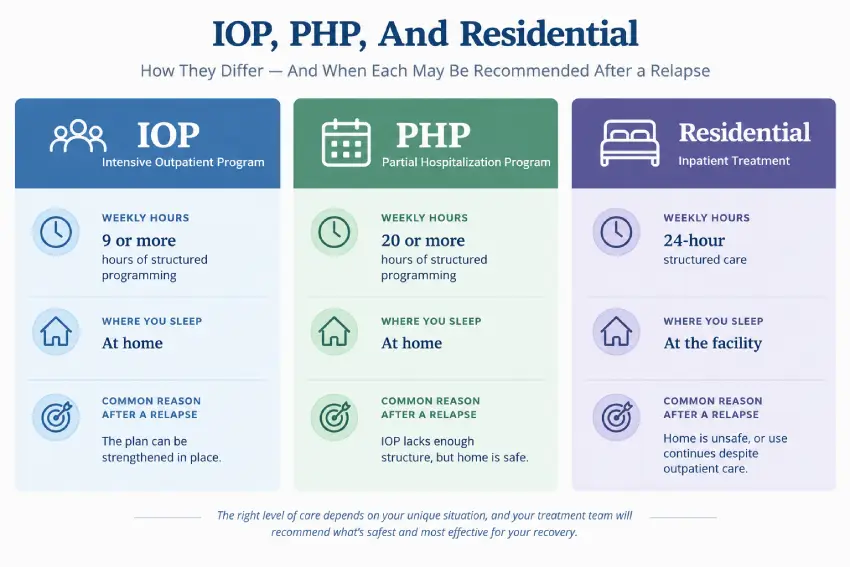
PHP and residential treatment are not interchangeable. They differ in weekly hours, supervision, and where you sleep.
When PHP Fits
PHP gives you a more structured day than IOP while you still sleep at home. It makes sense when IOP does not provide enough structure, when use keeps recurring despite added support, or when mental health symptoms need closer daily monitoring. It also depends on having a safe home and a reliable way to get to treatment. Some people also use PHP as a step down from residential care.
When Residential Treatment Fits
Residential treatment provides a 24-hour structured environment. A team may recommend it when you cannot stay safe at home, when use continues despite outpatient care, or when the people and places around you keep pulling you back to use. It can also fit when withdrawal needs medical monitoring or when co-occurring symptoms are severe.
Returning To IOP After Detox, PHP, Or Residential Treatment
There is no fixed sequence. Some people move from detox to residential care, then PHP, then IOP. Others go from a short detox stay straight back to IOP. After stabilization, a team reassesses you and decides whether a lower level of care is appropriate.
Step-down should be gradual, moving from several contacts per week to weekly contact and then less often, because an abrupt shift from intensive treatment to discharge is destabilizing for many people. Before you leave a higher level of care, ask for your next appointments to be scheduled, your medications to be arranged, and your housing to be confirmed.
Will You Be Discharged From IOP For Relapsing?
The fear of being removed is one of the main reasons people hide a relapse but a relapse does not mean treatment has failed. Many programs do not discharge someone for relapse alone, but policies vary, so it helps to know what yours says.
Discharge Policy Versus A Clinical Recommendation
These are two different things. A discharge policy is a rule set the program follows. Some programs have rules about behavior at the program itself, such as using or bringing substances on site or disrupting other clients’ treatment. A clinical recommendation comes from your needs. If your team concludes that IOP cannot keep you safe, it may recommend PHP, residential care, or detox, and a well-run program treats that as a planned referral.
Ask these questions before you need the answers:
- What does the written policy say about relapse and positive tests?
- Does a positive test change my enrollment status?
- What would lead you to recommend a higher level of care?
- Who arranges the transfer if one is needed?
If Your Program Cannot Continue Treating You
If your program cannot meet your needs, it should explain why and help plan the next step. A good transfer includes referrals to specific programs, your records sent with your permission, and appointments scheduled before you leave. It also includes a safety plan for any gap before the next service starts.
If a gap is likely, ask who you can call, whether check-ins or medication refills continue in the meantime, and what to do if symptoms worsen. You can reach 988 at any time, and FindTreatment.gov lists treatment programs near you. This matters because early dropout raises relapse risk, and a planned handoff keeps you connected to care.
Who Finds Out: Privacy, Family, And Employers After A Relapse
Your IOP team generally cannot tell your family or employer about a relapse without your consent. Two sets of rules apply. HIPAA protects health information broadly, and 42 CFR Part 2 adds protections for records from many federally assisted substance use treatment programs. Part 2 generally requires your written consent before a covered program discloses your records, with limited exceptions listed in the regulation, including medical emergencies.
A 2024 federal rule changed some of these details, and the compliance date was February 16, 2026. HHS says a single consent can now cover future disclosures for treatment, payment, and health care operations, which is how a program can share information with your insurer to bill for care. HHS also states that your treatment records cannot be used to investigate or prosecute you without your written consent or a court order.
Does Relapsing During IOP Mean Treatment Has Failed?
No. NIDA reports that relapse rates for substance use disorders, 40 to 60 percent, are similar to rates for hypertension and asthma, both 50 to 70 percent. Hence, relapse serves as a sign for resumed, modified, or new treatment and indicates a need to reinstate or adjust treatment and does not mean treatment has failed.
Setbacks are a normal part of progress, caused by insufficient coping skills or inadequate planning, which are problems that can be fixed. The progress you made before the relapse, including the skills you learned and the time you spent sober, remains part of your history.
The more useful question is what the relapse shows about your current plan. It may point to a gap in support, an untreated symptom, a medication that needs review, or a level of care that no longer fits. Your team can act on each of these, and that is the purpose of the reassessment.
What To Do If You Relapse During IOP
If you relapse during IOP, take these steps in order:
- Get emergency help if your health is at risk. Call 911 or go to an emergency room if you think you have overdosed or feel severely intoxicated, or if you have chest pain, trouble breathing, a seizure, hallucinations, or confusion. Do not wait to reach your therapist first.
- Contact your treatment team promptly. Call the program’s main number and ask for your therapist or the on-call clinician. Many programs have after-hours contact for urgent concerns, so ask about this ahead of time.
- Be specific about what happened. Have the substance, the amount, the time, anything else you took, your medications, and your symptoms ready. If you cannot remember exact amounts, give your best estimate and say it is an estimate.
- Follow the assessment and the revised plan. That may include added testing, a medication change, extra sessions, or a referral for detox or a higher level of care. Ask what each change is meant to address.
- Ask about the next level of care if one is recommended. Ask who arranges the transfer, when it starts, how your treatment continues in the meantime, and what your insurance requires.
Conclusion: A Relapse Requires A Response, Not An Assumption
A relapse during IOP calls for a clinical response. It does not prove that treatment failed, and it does not mean you will automatically be removed from care. If you have used while enrolled, contact your treatment team, be honest about what happened, and ask for a clinical assessment so the right level of care can be chosen.
If you want to talk through your options, we can explain how an assessment works and discuss which levels of care may fit your situation.