

-
 Written By:
Erin Andrade, LICSW
-
Edited By:
Phyllis Rodriguez, PMHNP-BC
-
Clinically Reviewed By:
Dr. Ash Bhatt, MD, MRO
 Written By:
 Edited By:
 Clinically Reviewed By:
Key takeaways
- OCD and anxiety need different treatment because different things keep them going. Anxiety treatment lowers overall worry. OCD treatment has to interrupt a specific ritual, almost always through Exposure and Response Prevention (ERP).
- Repeatedly reassuring someone with OCD can make their symptoms worse. Answering “are you sure?” gives short-term relief, but it teaches the brain that certainty is required before the fear can pass.
- If OCD treatment “isn’t working,” check whether ERP was actually used. Many people labeled treatment-resistant only received general therapy or medication, never structured ERP at the right frequency.
- When ERP and medication haven’t resolved OCD, TMS (Transcranial Magnetic Stimulation) is an FDA-cleared next step. It’s a noninvasive brain-stimulation treatment, and it’s typically considered only after standard treatment has been given a real chance first.
OCD and anxiety disorders share a lot of the same symptoms: racing thoughts, physical tension, avoidance, and a constant need for reassurance. But they are not the same condition, and they don’t respond to the same treatment. Anxiety treatment is built around reducing excessive worry and avoidance. OCD treatment is built around breaking the obsession-compulsion cycle, primarily through Exposure and Response Prevention (ERP), with medication used alongside it when appropriate.
If you’re trying to figure out whether what you or someone you love is dealing with is anxiety, OCD, or both, this article walks through how the two conditions differ, how they overlap, and what that difference means for choosing the right kind of treatment.
What is the real difference between OCD and anxiety?
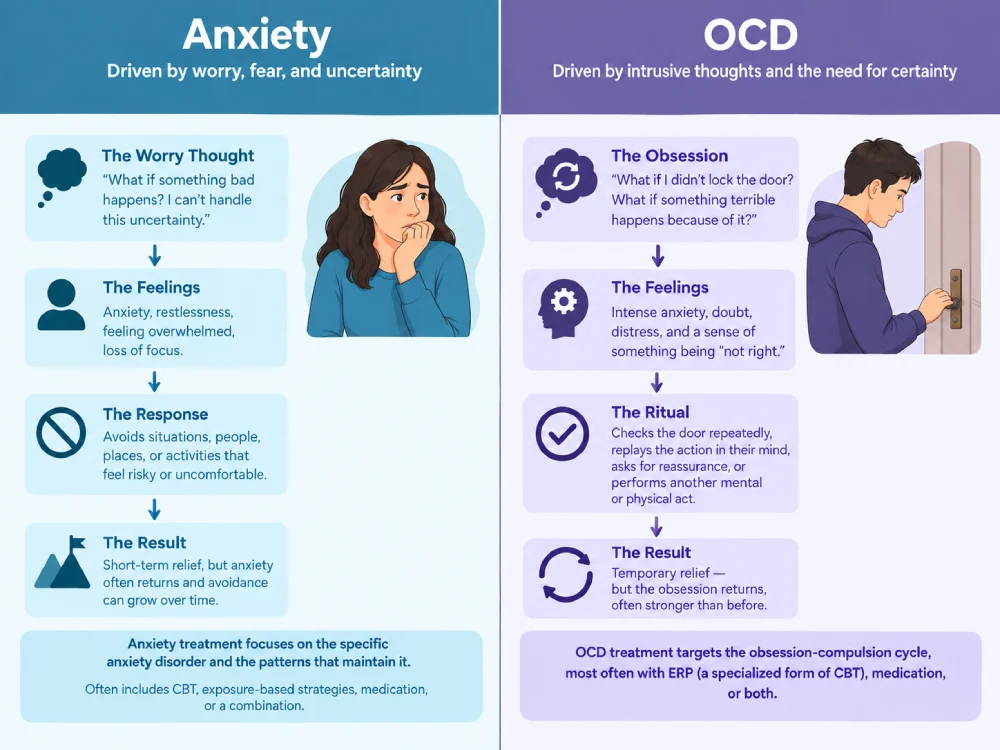
Anxiety disorders involve excessive fear, worry, or avoidance connected to real-life concerns, like health, money, or relationships, even when the actual risk is low. OCD works differently. It pairs obsessions, which are intrusive and unwanted thoughts, with compulsions, which are repetitive behaviors or mental acts done specifically to cancel out those thoughts.
| Anxiety | OCD | |
| What drives it | Worry about a real-life concern | An intrusive thought the person doesn’t want or believe in |
| What follows | General avoidance or worry | A specific, repeated ritual |
| Purpose of the behavior | Reduce discomfort broadly | Prevent one specific feared outcome |
| How relief feels | Fades naturally over time | Temporary, then the doubt returns |
| Classification | Anxiety disorder | Obsessive-compulsive and related disorder (separate category in the DSM-5) |
Here’s an example. Two people repeatedly check that their front door is locked. One person is anxious about forgetting things and finds uncertainty uncomfortable, so they check once or twice and move on. The other person has OCD, and believes that if they don’t check in a specific way, something terrible will happen to their family. They may check ten, twenty, or more times before the feeling of “rightness” settles.
This distinction is the reason OCD is now classified separately from anxiety disorders in the DSM-5, even though anxiety is present in nearly every OCD case. According to NIMH, 19.1% of U.S. adults had an anxiety disorder in the past year, compared with roughly 1.2% who had OCD. OCD is far less common, but it gets mistaken for generalized anxiety far more often than people expect.
How OCD and anxiety symptoms overlap
Both conditions can cause racing thoughts, restlessness, poor sleep, muscle tension, and reassurance-seeking. This overlap is exactly why OCD gets missed for years and treated as generalized anxiety instead. The question that actually helps isn’t how anxious someone feels. It’s what they do right after the fear shows up.
- Anxiety example: “What if I made a mistake at work?” You check the email once or twice, and the worry fades by the end of the day.
- OCD example: “What if I sent something harmful?” You reread the message several times, mentally replay the conversation, and ask someone to confirm nothing went wrong. The relief lasts a few minutes before the doubt comes back.
- Worry in anxiety tends to move between several real concerns over the course of a day. Obsessions in OCD tend to fix on the same theme repeatedly, such as contamination, harm, symmetry, or morality.
- Avoidance in anxiety is usually broad, like skipping a flight or avoiding a difficult conversation. Compulsive behavior in OCD is narrow and follows a strict internal rule, like a fixed washing sequence, a specific counting pattern, or reading a sentence a set number of times until it “feels right.”
- Reassurance-seeking happens in both conditions. In anxiety, it’s usually a one-time check that resolves the worry. In OCD, it’s repeated, tied to the same doubt, and only ever provides short relief.
Clinical perspective from Dr. Ash Bhatt: I ask every patient one question for clarification: “If you didn’t do the behavior, what do you believe would happen?” With anxiety, the answer is usually vague discomfort. With OCD, the answer is often a specific, feared consequence tied to a ritual, and that specificity tells me exactly which treatment protocol to reach for first.
Why OCD often gets missed or mistaken for anxiety
There are a few specific reasons OCD gets missed, beyond just symptom overlap.
- People notice the fear before they notice the ritual. Someone might describe feeling constantly anxious and unable to stop checking, without ever connecting the checking to the fear as one single cycle. The anxiety is what gets reported to a doctor. The compulsion behind it often isn’t mentioned unless someone asks about it directly.
- Insight varies more than most people expect. A person with OCD can fully know their fear is irrational and still feel unable to stop responding to it. Knowing a fear doesn’t make sense doesn’t make the compulsion optional. This is different from how most people imagine OCD working, and it’s part of why family members sometimes assume the person could just “choose” to stop.
- Shame keeps a lot of OCD hidden. Intrusive thoughts about harm, taboo subjects, or morally unacceptable ideas are common OCD themes, but people are often too embarrassed or frightened to describe them to a clinician, a partner, or even themselves. Without that detail, the presentation can look like plain anxiety or depression.
Mayo Clinic notes that OCD can closely resemble anxiety disorders and depression, which is why an accurate diagnosis depends on directly asking what the obsession is about and what the compulsion is meant to prevent, not just how anxious someone feels.
How clinicians diagnose OCD versus anxiety disorders
Diagnosis starts with a structured clinical interview covering symptom pattern, how long symptoms have lasted, and how much they affect daily functioning. From there, clinicians typically use different tools depending on what they suspect:
- For OCD, the Yale-Brown Obsessive-Compulsive Scale (Y-BOCS) measures the type and severity of obsessions and compulsions.
- For anxiety, tools like the GAD-7 measure how intense and frequent the worry is.
- For both, the clinician also screens for depression and substance use, since these commonly occur alongside OCD and anxiety and can change the treatment plan.
The real diagnostic work comes down to one question: what happens when the fear starts, and what do you do to make it stop? The answer shows whether someone is dealing with general worry, panic, avoidance, or a specific compulsion loop that needs to be named and targeted directly.
This distinction has real stakes. More than half of adults with OCD in the past year report serious problems with daily functioning, according to NIMH. Getting the diagnosis right early can save months, sometimes years, of being treated for the wrong condition.
What makes OCD treatment different from anxiety treatment
Both conditions can involve CBT and medication, but the specific techniques and treatment targets diverge sharply once you look past the surface.
| Anxiety treatment | OCD treatment | |
| Core therapy | CBT, matched to the specific disorder (GAD, panic, social anxiety) | Exposure and Response Prevention (ERP), a specialized form of CBT |
| Medication dosing | Standard SSRI or SNRI doses | Often much higher SSRI doses than used for depression |
| Main treatment goal | Lower overall worry and avoidance | Break the obsession-compulsion cycle directly |
| Role of reassurance | Usually just helpful support | Can become part of the ritual if given repeatedly |
| Family’s role | Support and encouragement | May need to reduce “accommodation” (helping with rituals) as part of treatment |
Reassurance is where this distinction causes the most confusion for families. In anxiety, Reassurance is where this distinction confuses families most. In anxiety, comfort from someone you trust is usually just comfort, and it helps. In OCD, if the same reassurance is asked for again and again about the same fear, and it only helps for a few minutes, it’s functioning as a compulsion, reinforcing the belief that certainty, not tolerance of uncertainty, is what makes the fear go away.
Did you know?
SSRIs for OCD are usually prescribed at higher doses than the same medication used for depression or anxiety, sometimes well above the standard range. This surprises most new patients, and it isn’t a sign that someone is more severely ill. It’s simply what the evidence shows the OCD circuit needs to respond. A prescriber who isn’t familiar with this can under-dose the medication and mistake a slow response for the treatment not working at all.
The role of CBT and ERP in OCD treatment
ERP is the first-line therapy for OCD with the strongest evidence behind it, according to the International OCD Foundation. The process works in three steps:
- Build a hierarchy. You and your therapist list your triggers from least to most distressing.
- Face the trigger. Starting with the easier ones, you deliberately expose yourself to the trigger, whether that’s a thought, an object, or a situation.
- Resist the compulsion. Instead of performing the ritual, you sit with the discomfort until it naturally drops on its own.
This is called habituation. Anxiety that isn’t relieved by a ritual eventually decreases without one. Your brain learns, through repeated experience rather than logic alone, that the feared outcome doesn’t actually require a compulsion to prevent it.
ADAA points out that the strongest predictor of whether ERP works is whether the therapist has you practice exposures during the session itself, not just talk about them afterward. That’s a fair question to ask any provider before you commit to a treatment plan.
How anxiety treatment works
Anxiety treatment targets the worry pattern itself, not one fixed ritual. CBT is widely used for anxiety disorder treatment and usually focuses on how you assess risk and how well you tolerate not knowing what will happen next, rather than confronting one narrow trigger.
While medication may also be appropriate depending on the diagnosis, severity, medical history, and individual preferences. It typically starts with standard-dose SSRIs or SNRIs. Beyond that, treatment is matched to the specific anxiety diagnosis:
- Generalized anxiety disorder – CBT targeting chronic worry, unhelpful risk assessment, and avoidance patterns
- Panic disorder – exposure to the physical sensations of panic itself, since fear of the sensations often drives the disorder
- Social anxiety disorder – gradual, structured exposure to feared social situations
- Specific phobia exposure narrowed to one feared object or situation
Clinical perspective from Dr. Ash Bhatt: The mistake I see most in generalized anxiety disorder treatment that’s been applied to undiagnosed OCD is over-reliance on relaxation and grounding techniques. Those techniques calm the nervous system, but if the underlying issue is a compulsion cycle, calming the person down actually functions as another form of ritual relief, and the cycle strengthens rather than fades.
When someone has both OCD and an anxiety disorder
A person can have both OCD and an anxiety disorder, and treatment may need to address both patterns. The presence of one diagnosis does not automatically explain every symptom.
You might have OCD-driven contamination rituals and a separate, ongoing pattern of worry about money or family that has nothing to do with the rituals at all. A thorough evaluation looks at which pattern is causing the most disruption, whether compulsions are present, and whether depression or substance use is part of the picture.
The answers help determine what should be treated first and whether therapies need to be combined.
When OCD or anxiety symptoms need a higher level of care
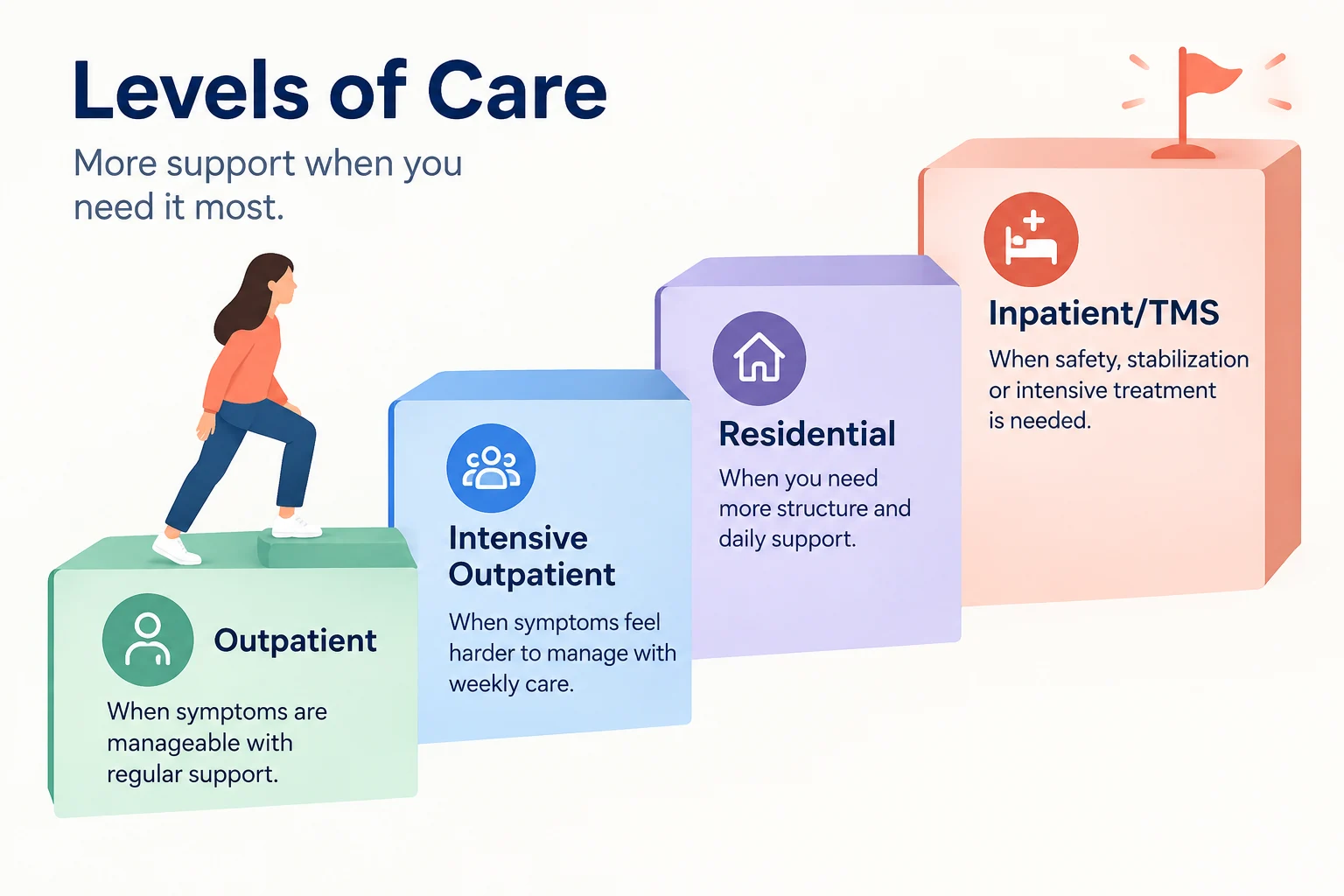
Most people improve with weekly outpatient therapy. When that’s not enough, it’s a clinical signal that treatment needs to intensify, not a sign that the person isn’t trying hard enough. Care generally moves through these stages, with the goal always being the least restrictive setting that’s still clinically adequate:
- Weekly outpatient therapy
- More frequent outpatient sessions
- Intensive outpatient program
- Residential treatment
- Inpatient or hospital-level care
What is intensive OCD treatment?
Intensive OCD treatment means multiple ERP sessions a week instead of one. It’s typically considered when standard weekly outpatient ERP hasn’t led to real improvement after a genuine trial period, or when compulsions are consuming enough of the day that once-a-week therapy can’t keep pace with them.
What is OCD residential treatment?
OCD residential treatment provides structured, daily ERP alongside psychiatric support in a live-in setting. It’s generally reserved for OCD severe enough to disrupt work, relationships, or basic daily functioning. It also gives clinicians a chance to observe and reduce family accommodation, where loved ones unintentionally take part in rituals or reassurance, in real time rather than by report.
When is inpatient anxiety treatment appropriate?
Inpatient anxiety treatment becomes relevant when anxiety comes with an inability to manage daily responsibilities, co-occurring depression, or safety concerns that need close monitoring, not simply because the anxiety feels severe on a given day. It’s a hospital-level setting meant for acute stabilization, not a first response to worsening worry.
What is TMS therapy for OCD treatment?
TMS therapy for OCD is a noninvasive brain-stimulation treatment, specifically deep transcranial magnetic stimulation, that received FDA clearance in 2018 for adults with treatment-resistant OCD. It’s considered a third-line option, used after ERP and medication have genuinely been tried first. According to the IOCDF, roughly half of patients see meaningful symptom reduction with TMS.
Note: Before moving to TMS, it’s worth asking a more basic question: was ERP, delivered by someone actually trained in it, given a real chance first, at a real frequency? A mismatch between the treatment given and the disorder present is sometimes mistaken for treatment resistance, when the actual issue is that the right treatment was never tried.
What If Alcohol or Other Substances Are Being Used to Manage Symptoms?
OCD and anxiety can become exhausting, and some people attempt to manage distress by drinking alcohol or using other substances. The short-term reduction in distress can make the behavior feel effective, even when it creates additional problems over time.
For treatment purposes, the important issue is not to assume that substance use explains the OCD or anxiety. Instead, clinicians should determine whether there is a co-occurring substance-use disorder, whether substance use is interfering with treatment, and whether withdrawal or intoxication is affecting psychiatric symptoms.
This can influence the appropriate level of care.
If stopping alcohol or another substance could produce withdrawal, medical guidance is important. Detoxification or medication changes should not be attempted based on an online article.
Determining the right level of care in the Boston area
For those in Boston and elsewhere in Massachusetts, the Massachusetts Behavioral Health Help Line can help individuals and families connect with mental health and substance-use services. The state says the BHHL is available 24/7 at 833-773-2445 by call or text.
For immediate emotional distress or a mental health crisis, the 988 Suicide & Crisis Lifeline is available 24/7 by call or text. You do not have to be suicidal to contact 988.
If there is an immediate life-threatening emergency, call 911 or seek emergency medical care.
For someone specifically looking for OCD treatment, the International OCD Foundation also provides educational information about evidence-based OCD treatment and ERP.
What to do next if you recognize these signs
If any of this sounds familiar, the next step is a clinical evaluation, not a guess based on an article. Ask a prospective clinician directly whether they’re trained in ERP and how they tell OCD apart from generalized anxiety, rather than just asking whether they treat anxiety in general.