


-
 Written By:
Erin Andrade, LICSW
-
Edited By:
Phyllis Rodriguez, PMHNP-BC
-
Clinically Reviewed By:
Dr. Ash Bhatt, MD, MRO
 Written By:
 Edited By:
 Clinically Reviewed By:
Key Takeaways
- Feeling depressed after quitting alcohol often means alcohol was hiding a problem that’s visible now because alcohol is no longer part of your life.
- Your mood can improve while you still feel terrible. Sleep and energy usually take longer to heal than sadness does.
- Do not wait for depression to pass on its own. Instead, watch whether it’s improving, and if it isn’t, that’s when you need to get help.
Feeling depressed after quitting alcohol can be disorienting, especially when you expected sobriety to make things better right away.
This article breaks down how long that depression typically lasts, why it happens in the first place, and how to tell the difference between a temporary withdrawal effect and a depressive disorder that needs its own treatment plan. We’ll also cover the warning signs that mean it’s time to stop monitoring and start evaluating.
How Soon Depression Usually Improves After You Quit Drinking?
For most people, depression related to quitting alcohol is worst in the first several days and starts easing noticeably within one to two weeks. One of the most detailed studies on this, looking at people hospitalized for alcohol dependence, found that 42% had clinically significant depression when they were admitted, but only 6% still did after four weeks of abstinence, with the biggest improvement happening around week two.
That’s an encouraging pattern, but it’s an average, not a guarantee. Some people feel noticeably better within days. Others carry low mood, fatigue, or disrupted sleep for a couple of months before things fully settle. What matters isn’t hitting some magic number of sober days, it’s whether things are trending in the right direction. If your mood is clearly better than it was two weeks ago, that’s a good sign, even if you’re not “back to normal” yet. If four to six weeks have passed and nothing has shifted, or if things have gotten worse, that’s no longer something to just ride out.
And if you’re having thoughts of suicide right now, none of the timelines below apply to you the way they apply to everyone else. Call or text 988 to reach the 988 Suicide & Crisis Lifeline, any time, day or night. That’s true whether you quit drinking yesterday or six months ago.
Why You Feel Depressed After Quitting Alcohol
Alcohol is a central nervous system depressant, and with repeated heavy use, the brain adjusts its own chemistry to offset alcohol’s effects. When drinking stops, that adjustment doesn’t reverse overnight, leaving the nervous system temporarily overcorrected.
The NIAAA describes this as part of the “negative affect” stage of the addiction cycle, a state where the brain’s reward system runs low while its stress systems run high. In practical terms, that means ordinary activities can feel flat and unrewarding right when stress and irritability are most noticeable.
There’s a psychological layer here too. If alcohol had become a way to manage loneliness, work stress, or anxiety, quitting removes the coping tool without removing whatever it was coping with. What surfaces afterward can feel like new depression, even when it’s really the return of something alcohol had been muting.
Sleep compounds all of this. Alcohol disrupts REM sleep even though it can make falling asleep easier at first, and the rebound insomnia that follows quitting can drag out for weeks, feeding fatigue, poor concentration, and low mood along the way.
Something Worth Knowing:
Studies on early recovery show that mood tends to improve before sleep does. Feelings like sadness, guilt, or feeling worthless usually get better fastest. Sleep and appetite take longer to return to normal, and are often still a problem even after mood has improved. So if you feel emotionally better but you’re still not sleeping well, that’s a normal part of the process.
How Alcohol and Depression Feed Each Other
Alcohol and depression have a two-way relationship, which is part of why “did alcohol cause my depression” doesn’t have a single answer. Alcohol can offer short-term relief from sadness or anxiety, which is exactly why people reach for it, but repeated use disrupts sleep and emotional regulation in ways that deepen depression over time.
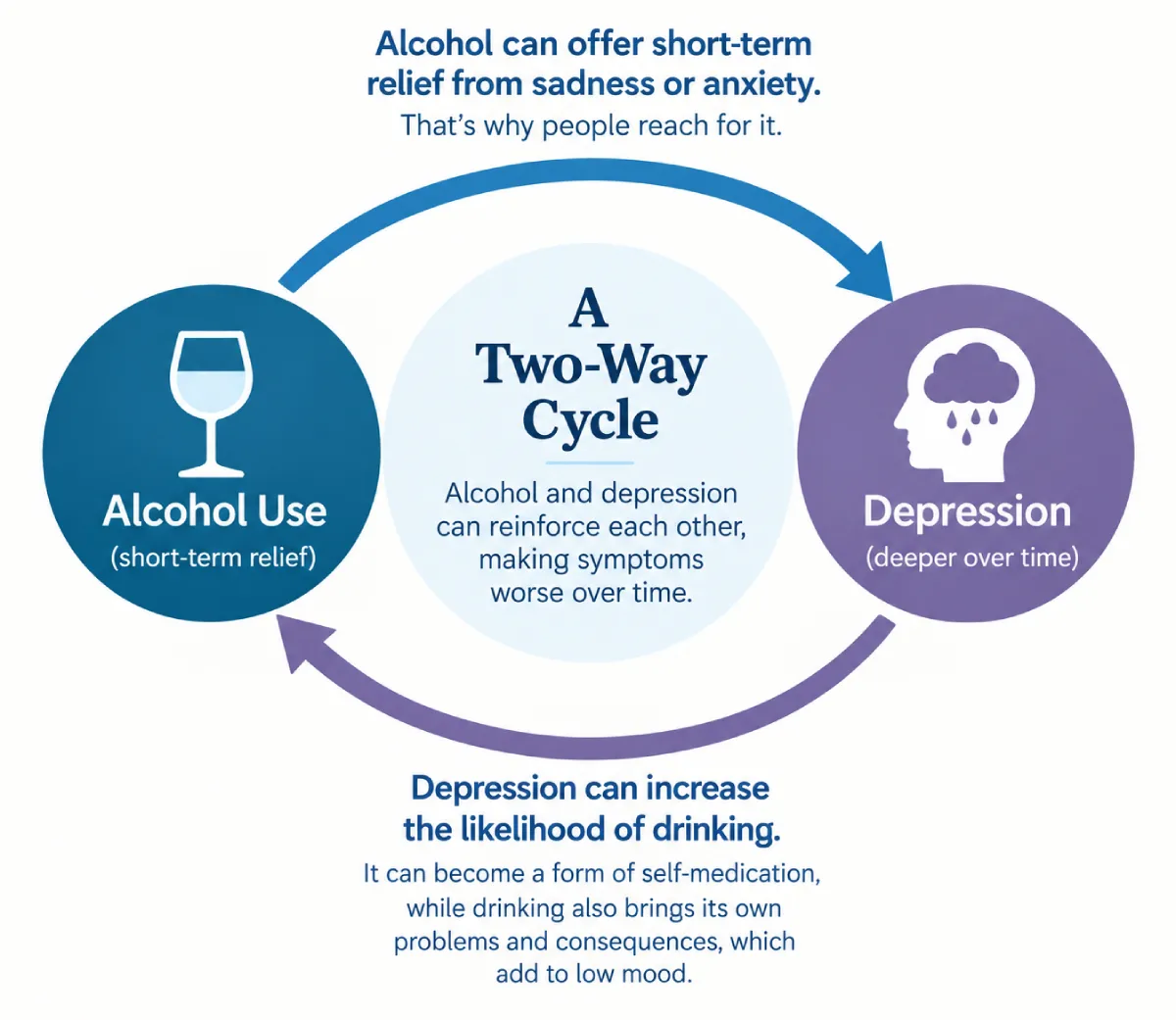
For someone already depressed, alcohol can become a form of self-medication. It briefly softens anxiety or loneliness, but that relief fades fast and rarely addresses what’s underneath it.
Drinking also tends to create its own downstream problems, strained relationships, missed responsibilities, financial stress, regret over behavior while drinking, and those consequences become additional sources of low mood on top of whatever depression was already there. The NIAAA links irritability, anxiety, and dysphoria directly to the withdrawal process itself, separate from any of these secondary stressors.
Can Alcohol Cause Depression?
Sometimes, yes, and sometimes it’s the other way around, with depression having come first and drinking developing as a response to it. Both patterns are real, and telling them apart is genuinely the most useful thing an evaluation can do for you.
Alcohol-induced depression tends to show up during or shortly after drinking or withdrawal, and it generally lifts as sobriety continues. An independent depressive disorder exists on its own terms, it doesn’t depend on alcohol to exist, and it usually doesn’t resolve just because drinking stops. According to a review from the NIAAA of national survey data, people with alcohol dependence are 3.7 times more likely to also have major depressive disorder than people without it, which tells you how often these two things travel together rather than existing as one clean cause and effect.
A few honest questions can help you get a sense of which pattern fits you, even before you talk to anyone:
- Did the low mood start before drinking became a real problem, or after?
- Have you ever felt this way during an earlier stretch of sobriety, even briefly?
- Is there depression in your family that has nothing to do with alcohol?
None of these questions give you a diagnosis on their own, but your answers are exactly what a good clinician will want to know, and having thought about them ahead of time makes that first conversation a lot easier.
What the First Few Weeks Typically Look Like
It can help to have a rough sense of the shape of this, even though everyone’s path looks a little different.
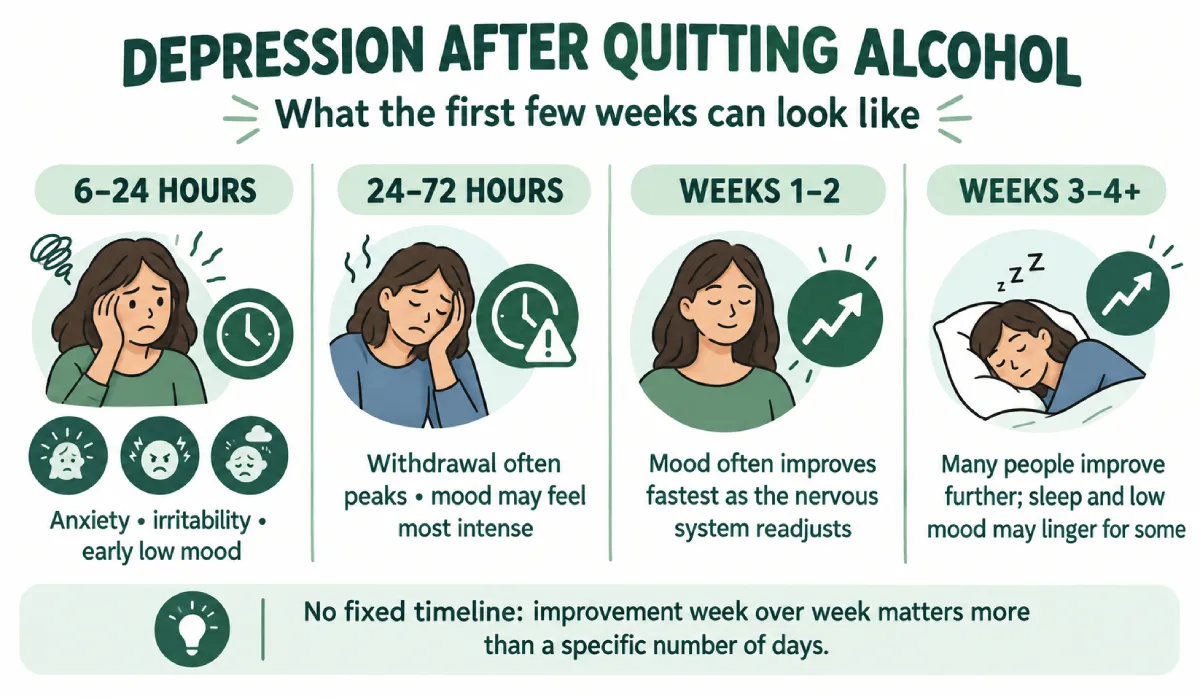
| Timeframe After Last Drink | What Commonly Happens to Mood |
| 6–24 hours | Anxiety, irritability, and early low mood alongside physical withdrawal symptoms |
| 24–72 hours | Physical withdrawal typically peaks; mood symptoms are often at their most intense |
| First 1–2 weeks | Depression scores tend to drop fastest during this window as the nervous system recalibrates |
| 3–4 weeks | Most people no longer meet criteria for clinically significant depression |
| 1–6 months | Sleep disruption and lower-grade low mood can persist in a subset of people |
Physical withdrawal symptoms typically begin within 6 to 24 hours and peak between 24 and 72 hours after the last drink, but prolonged symptoms like insomnia and mood changes can last for weeks or months in some people. This table describes a general pattern, not a fixed schedule, and severe or complicated withdrawal always warrants medical attention through supervised alcohol detox.
Separately, in an animal model, researchers at UNC’s Bowles Center for Alcohol Studies found that depression-like behavior was still evident 14 days after alcohol was stopped, even at moderate drinking levels, tied to reduced neuron production in the hippocampus. That’s mouse research, but it supports something clinicians see anecdotally: abstinence itself, not just active drinking, can temporarily strain the brain’s mood systems.
Alcohol-Induced Depression vs. an Underlying Depressive Disorder
The more useful question is when it started, how it’s changing with abstinence, and whether it predates the drinking. Two patterns illustrate the difference:
- Alcohol-related pattern: Low mood develops or worsens during heavy drinking, intensifies during withdrawal, and then steadily improves over the following weeks as sobriety continues.
- Independent disorder pattern: Depressive episodes occurred before problematic drinking began, including during past periods of sobriety, and current symptoms plateau or worsen rather than improving on the same timeline.
- Mixed picture: A person can have alcohol use disorder and major depressive disorder at the same time, which is common enough that treating only one rarely resolves the other.
Family history of depression unrelated to drinking also raises the likelihood that current symptoms reflect an independent condition rather than a withdrawal effect.
Clinical Insight from Dr. Ash Bhatt:
Doctors usually wait about four weeks of sobriety before starting antidepressant medication, unless symptoms are severe. This is because it’s hard to tell whether the medication is helping, or whether the depression was already improving on its own as the body recovers from withdrawal. Waiting helps get a clearer answer.
What Makes Depression Last Longer for Some People?
A handful of specific factors extend the recovery window well past the typical few weeks. None of these factors mean recovery isn’t happening. They just mean the timeline for some people is genuinely longer than the average, and that’s worth knowing so you’re not measuring yourself against a number that was never going to fit your situation.
- Sleep disruption. REM rebound after quitting can cause fragmented sleep and vivid dreams for weeks, and poor sleep directly worsens mood.
- Severity and duration of drinking. Years of heavy daily use take longer for GABA and glutamate systems to rebalance than shorter or lighter drinking histories.
- Co-occurring anxiety. Anxiety and depression frequently overlap in early recovery, and untreated anxiety can prolong depressive symptoms.
- Other substance use. Nicotine, benzodiazepines, or other substances used alongside alcohol complicate and extend both withdrawal and mood recovery.
- Pre-existing depression or anxiety. A prior diagnosis, even one that was never treated, raises the odds that current symptoms are independent rather than withdrawal-related.
- Medical conditions. Thyroid dysfunction, chronic pain, and liver complications from long-term drinking can all independently affect mood.
When Depression After Quitting Alcohol Is More Than Withdrawal
Depression that’s mild and steadily improving can often be monitored during early recovery. Depression that’s severe, static, or worsening deserves evaluation rather than more time.
Warning signs worth acting on include:
- Persistent hopelessness or feelings of worthlessness
- Loss of interest in activities that previously mattered
- Significant difficulty functioning at work, school, or home
- Depression that hasn’t improved at all after four to six weeks of sobriety
- Repeatedly returning to alcohol because sobriety makes the emotional symptoms hard to tolerate
- Depression that existed before problematic drinking began
- Thoughts of death, self-harm, or suicide
If you or someone you know is having thoughts of suicide, call or text 988 to reach the 988 Suicide & Crisis Lifeline, available 24/7. If there’s immediate danger, or signs of severe withdrawal like seizures, hallucinations, or confusion, call 911 or go to the nearest emergency room.
How Clinicians Evaluate Depression During Alcohol Recovery?
Diagnosing depression right after someone stops drinking is genuinely harder than diagnosing it otherwise, because withdrawal itself produces symptoms that overlap with depression, poor sleep, low energy, loss of interest, difficulty concentrating. That overlap is exactly why NIMH’s criteria for a major depressive episode require symptoms most of the day, nearly every day, for at least two weeks, a bar that helps separate a bad few days of withdrawal from something more persistent.
Because of that overlap, many clinicians wait until acute withdrawal has passed, generally two to four weeks of sustained abstinence, before making a formal diagnosis, unless symptoms are severe enough to require immediate intervention. This is how clinicians avoid mistaking a temporary withdrawal effect for a chronic condition, or dismissing real depression as “just withdrawal.”
A full evaluation typically covers the drinking history, when depressive symptoms first appeared relative to that history, family history of depression, other substance use, and a physical exam to rule out contributors like thyroid dysfunction. Anxiety, trauma-related conditions, and bipolar disorder are also screened for, since they commonly travel alongside both alcohol use and depression.
Treatment When Alcohol Use and Depression Occur Together
When both conditions are present, treating only one tends to leave the other to undermine progress on the first. This is the logic behind dual-diagnosis care, which treats alcohol use disorder and depression within a single coordinated plan instead of two separate, sequential ones.
An integrated plan can draw on several pieces at once:
- Medically supervised alcohol detox for anyone with a heavy drinking history, since withdrawal can carry real medical risk and shouldn’t be managed alone.
- Individual therapy, particularly cognitive behavioral therapy, to address the thought patterns sustaining both the depression and the drinking.
- Psychiatric medication management, when appropriate, timed and monitored by a provider who understands how mood medications interact with recent alcohol use.
- Group therapy or peer support, which has been associated with meaningful reductions in depressive symptoms during recovery.
- Ongoing follow-up care after residential or outpatient treatment ends, since mood symptoms can resurface months into sobriety.
“What to do next: If two or more of these apply to you- withdrawal risk, depression interfering with daily life, past relapse after trying to quit alone- that’s the threshold for asking about a dual-diagnosis program specifically.”
What to Do If Depression Isn’t Improving
If it’s been more than six weeks since your last drink and your mood/sleep log shows no real improvement, here’s the actual next step:
- Call your primary care doctor or a psychiatrist this week and say specifically: “I quit drinking six-plus weeks ago and my depression hasn’t improved — I need an evaluation for a possible co-occurring disorder.” That phrasing gets you routed correctly the first time.
- Bring your symptom log. Concrete data (sleep hours, mood ratings, dates) moves an evaluation faster than a general description of “feeling bad.”
- Ask directly whether dual-diagnosis treatment is appropriate rather than waiting to be offered it, many primary care visits default to a single-issue referral unless you ask.
- Do not treat a return to drinking as a fix. If you’re tempted because sobriety feels worse than drinking did, that’s information to give your provider, not a decision to act on alone.
- If you’re a loved one reading this on someone else’s behalf: name the specific changes you’ve noticed (“you’ve stopped doing X, you’re sleeping at strange hours”) rather than a general “are you okay,” and offer to help schedule the appointment, not just suggest it.
Final Thought
Depression after quitting alcohol can be part of the difficult transition into sobriety, but it should not automatically be dismissed as something that will disappear with time. Many people experience meaningful improvement in depressive symptoms during the first several weeks of abstinence, while others continue to struggle because an underlying depressive disorder or another mental-health condition is also present.
The most important question is not whether you have reached a particular number of sober days. It is whether your mood is gradually improving, remaining severely impaired, or becoming worse.
If depression persists, interferes with your ability to function, repeatedly drives you toward alcohol, or includes thoughts of suicide or self-harm, professional evaluation is warranted. When alcohol use and depression occur together, treatment that addresses both can provide a clearer path forward than trying to manage either problem alone.